Comparative Analysis
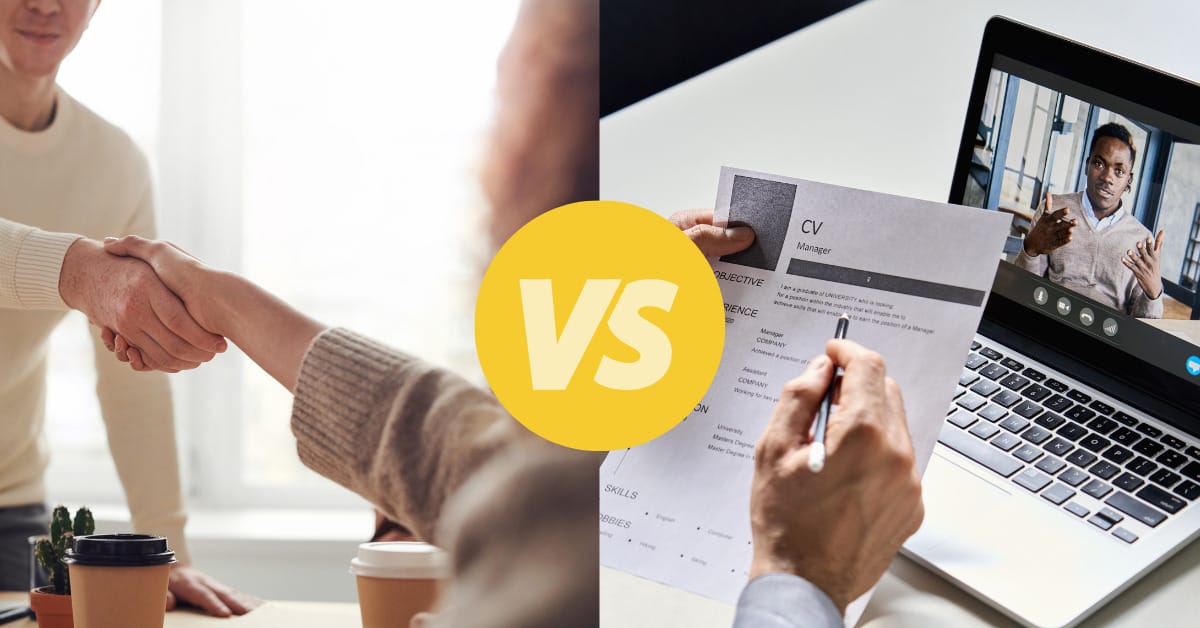
In the contemporary job market
characterized by rapid changes, the recruitment process has undergone
significant transformation. Among the notable shifts is the increased
prevalence of online interviews alongside traditional in-person interactions.
This article aims to provide a comprehensive examination of the benefits and
drawbacks associated with each approach, offering insights for recruiters to
navigate the evolving landscape effectively.
Online interviews offer unparalleled
simplicity and accessibility, enabling recruiters to engage with candidates
from any location worldwide. Platforms such as Zoom, Skype, and Microsoft Teams
facilitate efficient communication, eliminating the need for travel and thereby
saving time and expenses. The removal of geographical constraints grants
businesses access to top talent irrespective of their location. Furthermore,
the more relaxed setting of online interviews may enhance credibility and
improve the overall application experience for candidates (Smith, 2021).
However, online interviews also
present certain challenges. Technical difficulties, connection issues, and the
inability to discern nonverbal cues may hinder the process. To mitigate these
risks, recruiters must ensure a reliable internet connection and familiarity
with the platform's functionalities. Establishing rapport and connecting with
applicants in a virtual context may require additional effort (Jones &
Patel, 2020).
In contrast, physical interviews
offer a conventional approach that facilitates in-person communication and a
more thorough assessment of candidates. Recruiters can provide a more immersive
experience, interpret body language, and evaluate cultural fit effectively.
Additionally, in-person interviews provide an opportunity to showcase the organizational
culture and atmosphere, influencing applicants' perceptions and decisions. The
informal setting of physical interviews may also enhance credibility and enrich
the candidate experience (Brown et al., 2019).
Nevertheless, physical interviews
come with logistical challenges such as scheduling conflicts, travel expenses,
and time constraints. Candidates from distant locations may face difficulties
accessing the interview process due to geographic barriers.
Many of us by far must have participated
or faced either a virtual or a physical interview at any point in our career
paths. Sri Lankan Airlines mostly thus far, has only conducted physical
interviews for its’ candidates even if the applicant numbers are higher. I had
the privilege to take part in the interviews conducted on behalf of the
training department for SriLankan Airlines. The exposure was priceless and I
got to learn and experience a lot of aspects related to the effectiveness of the
major two types of interviews. The in-person interviews carries a more weightage
in terms of the human touch and helping both parties raise fairly a good awareness
on each other which in-fact becomes the foundation for future employee-employer
relationship. This core value is often missed when it comes to virtual
platforms. Nevertheless, both pros and cons are in abundant with both methods
and my personal evaluation is to best assess the ideal method only after a
proper assessment of the productivity and the quality an employer expects from
an interview and decide on the best suited method rather than merely sticking
to either one on the basis of principle. Thus, organizations should know what method
to use based on their core understanding on different interview types. I would
like to describe in brief as below for further clarity.
Types of Interviews
Let's
explore the various kinds of interviews conducted:
·
Structured Interview:
In
structured interviews, all candidates are asked the same set of questions,
which can be either open-ended (allowing for multiple answers) or close-ended
(requiring a single answer). Interviewers use candidates' responses to compare
and evaluate them (Kvale & Brinkman, 2008).
·
Unstructured Interview:
In unstructured interviews, questions may change based on the candidate's responses to previous questions. There's no fixed format, and interviewers might ask unexpected questions based on the flow of the interview (Rogers, Carl R, 1945).
·
Stress Interview:
Stress
interviews are designed to assess how candidates respond under pressure. They
evaluate whether candidates can handle stressful situations constructively,
which is particularly relevant for high-stress job roles (Freeman, G. L., Manson, 1942).
·
Situational Interview:
In
situational interviews, candidates are presented with a scenario or
problem—either hypothetical or real—and are asked to propose a solution. The
goal is to gauge problem-solving skills (Maggie Lu, 2002).
·
Behavioral Interviews:
Behavioral
interviews focus on evaluating a candidate's past behaviors and experiences to
predict future performance (G. E.,
Katzoff, 1945).
·
Technical Interviews:
Technical
interviews assess a candidate's specific technical knowledge, skills, and abilities
related to the job's technical requirements (McDowell, Gayle Laakmann (2015).
·
Off-site Interview:
Off-site
interviews are informal meetings conducted outside the office, often over lunch
or in a different setting. The aim is to assess the candidate's personality
beyond the workplace.
·
Video or Phone Interviews:
Video
or phone interviews involve remote communication between the candidate and
interviewer.
·
Working Interview:
During
a working interview, candidates are assigned a task to showcase their actual
skills. Employers assess performance based on this task, allowing candidates to
demonstrate practical abilities relevant to the job.
·
Exit Interview:
Exit
interviews provide companies with insights into why employees leave their jobs.
Employers interview departing employees to gather feedback on their work
experience, enabling the company to make workflow improvements based on this
feedback (Datta Rahul, 24 May
2023).
Types
of Interview Models
Below
are the different types of interview models used by companies (Darci Davis,
2023).
·
Individual Interviews:
Individual
interviews involve a private interaction between a candidate and an
interviewer, allowing for a focused exploration of the candidate's background
and qualifications. This format is commonly used for initial screenings and
final selection stages.
·
Group Interviews:
Group
interviews assess multiple candidates simultaneously through discussions or
collaborative activities. This format evaluates teamwork and communication skills
by observing candidate interactions.
·
Panel Interviews:
Panel
interviews feature multiple interviewers from different departments or levels
interviewing a candidate together. This format provides diverse perspectives
and is often used in the final stages of selection.
·
Multiple-Round Interviews:
Multiple-round
interviews require candidates to progress through several interview stages,
allowing for a comprehensive assessment over time.
·
Computer-Assisted Interviews:
Computer-assisted
interviews utilize technology like AI or pre-recorded questions to assess
candidates remotely. This format includes software-based screening and
evaluation processes, sometimes incorporating video responses to predetermined
questions, making it efficient for large-scale recruitment efforts.
What
Companies Seek in Interviews?
During
interviews, companies aim to evaluate a candidate's suitability for a specific
role and their alignment with the organization. While criteria may vary, common
aspects companies assess include (Indeed Editorial Team, 2023).
·
Technical Skills - Mastery
in job-specific skills and problem-solving abilities. Industry knowledge and
awareness of trends.
·
Soft Skills - Effective
communication, teamwork, and adaptability.
·
Cultural Fit - Alignment
with company values and team compatibility.
·
Motivation and Engagement - Genuine
interest in the role and initiative in exceeding expectations.
·
Problem-solving Abilities - Critical
thinking and creativity in approaching challenges.
·
Leadership Potential - Proactive
attitude and effective decision-making skills.
·
Cultural Awareness - Appreciation
for workplace diversity and global perspectives.
·
Interpersonal Skills - Relationship
building and conflict resolution capabilities.
·
Work Ethic - Dependability
in meeting deadlines and managing time effectively.
·
Emotional Intelligence - Self-awareness
and empathy towards others' emotions.
·
Professionalism - Ethical
conduct and maintaining a professional demeanor.
In interviews, these qualities collectively help companies gauge a candidate's potential contribution to the team and overall organizational success.
In summary, both in-person and
virtual interviews have their merits and limitations, and the choice between
them depends on various factors including applicant preferences, recruitment
objectives, and organizational culture. Recruiters can navigate the recruitment
landscape successfully by understanding the nuances of each approach and
leveraging appropriate tools and strategies.
References:
Brown, A., White, B., & Black, C. (2019). Enhancing Candidate Experience Through In-Person Interviews. Journal of Recruitment Strategies, 12(2), 45-58.
Dipboye, R. L., Macan, T., & Shahani-Denning, C. (2012). The selection interview from the interviewer and applicant perspectives: Can't have one without the other. In N. Schmitt (Ed.), The Oxford handbook of personnel assessment and selection (pp. 323–352).
Jones, R., & Patel, S. (2020). Overcoming Challenges in Virtual Interviews: Strategies for Recruiters. International Journal of Human Resource Management, 25(3), 210-225.
Kvale & Brinkman. 2008. InterViews, 2nd Edition. Thousand Oaks: SAGE. ISBN 978-0-7619-2542-2.
Maggie Lu, The Harvard Business School
Guide to Careers in Management Consulting, 2002, page 21, ISBN 978-1-57851-581-3.
Memon, A., Cronin, O., Eaves, R., Bull, R.
(1995). An empirical test of mnemonic components of the cognitive interview. In
G. Davies, S. Lloyd-Bostock, M. McMurran, C. Wilson (Eds.), Psychology, Law,
and Criminal Justice (pp. 135–145). Berlin: Walter de Gruyer.
Miller, Claire Cain
(25 February 2016). "Is Blind
Hiring the Best Hiring?". The New York Times.
Merriam Webster Dictionary, Interview,
Dictionary definition, Retrieved February 16, 2016.
Rogers, Carl R. (1945). Frontier Thinking in Guidance. University of California: Science research associates. pp. 105–112. Retrieved March 18, 2015.
Smith, T. (2021). The Rise of Virtual Interviews: Implications for Recruitment Practices. Journal of Talent Acquisition, 8(1), 67-82.
The stress interview. The Journal of Abnormal and Social
Psychology, 37(4), 427–447. https://doi.org/10.1037/h0059025.
"The Value
or Importance of a Job Interview". Houston
Chronicle. Retrieved 2014-01-17.
Willis, Gordon
(2005). Cognitive interviewing: A tool for improving questionnaire design.
Sage. p. 146. ISBN 9780761928041.


This article explores the benefits and drawbacks of online and traditional in-person interviews in the rapidly changing job market, providing valuable insights for recruiters.
ReplyDeleteAlso at the end you have given your personal exposure of your organizational interview process is so vital and added more essence to the post!
Thank you for sharing your insights on the benefits and drawbacks of online and traditional in-person interviews in the evolving job market. Thank you.
ReplyDeleteThe recruitment process has evolved significantly, with an increased prevalence of online and traditional in-person interviews. Online interviews offer simplicity, accessibility, and reduced travel costs, while physical interviews provide a more thorough assessment of candidates. However, they also present challenges like technical difficulties and connection issues.
ReplyDeleteYou're absolutely right! The recruitment process has indeed evolved, with both online and traditional in-person interviews playing significant roles. Online interviews offer convenience, accessibility, and cost savings, while physical interviews allow for a more in-depth evaluation of candidates. However, each method comes with its own set of challenges, such as technical issues in online interviews and logistical concerns in physical interviews. Overall, organizations often use a combination of both approaches to ensure a comprehensive and effective recruitment process.
ReplyDeleteThis blog post explored the value of interviews—in-person or virtual—in the employment process and how they help companies assess candidates' qualifications, backgrounds, and organizational fit. Companies might think about interview recommendations for both of this kinds to guarantee a good interview experience. Making a good impression in both situations requires professionalism, planning, and effective communication.
ReplyDeleteThank you for sharing! Interviews, whether in-person or virtual, are crucial for companies to evaluate candidates effectively. Providing recommendations for both types of interviews ensures a positive experience for both parties. Professionalism and thorough planning are key to making a good impression regardless of the format.
ReplyDelete